The signs are usually visible long before anyone takes action. Production delays are
becoming more frequent. Profit margins are shrinking. Senior leadership is too busy
fighting fires to focus on strategic initiatives
Your projects are nuanced and capital-intensive. But the
systems you’re using to manage them can no longer keep
up with the volume or complexity.
Your technology environment looks something like this:
Nicholas Wood, Solution Architect at Momentum Software Solutions, says the signs are there for anyone who knows what to look for.
“Growing manufacturers often have an accounting package, but
they’re supporting that with a lot of spreadsheets. Those bridges get
convoluted, error-prone, and slow. Prices and markets change, so
they can quickly become unusable or out of date.”
SOLUTION ARCHITECT,
MOMENTUM SOFTWARE SOLUTIONS
Behind the technology, there’s a human reality.
The factory floor runs on exclusive knowledge and a
handful of workers who know where everything is.
Then one day, a production manager takes a holiday,
and all of that knowledge leaves with him. Or you make
commitments to multiple customers without the
capacity to deliver them, and you’re forced to choose
between expensive shortcuts and missed deadlines.
“They’ll promise three customers projects
when they’ve only got the capacity to make
one. All of a sudden, they have to use
external contractors or expensive
externals that weren’t originally costed in.”
SOLUTION ARCHITECT,
MOMENTUM SOFTWARE SOLUTIONS
When those shortcuts mean hiring external
contractors to fill the gaps, a job that was supposed
to be profitable becomes a net loss – and nobody is
aware of it until month-end.
These challenges present greater difficulty for configure‐to‐order and engineer‐to‐order manufacturers, where every job introduces new variables: custom designs, customer‐specific components, evolving specifications, and engineering changes that don’t always arrive neatly before production starts.
Quotes based on “the last similar job,” even whenthe
differences materially affect cost or lead time.
Engineering changes are communicated
informally – via email, marked‐up PDFs, or
conversations on the factory floor – making it
unclear which version is current
BOMs evolve during production, but costing and
scheduling don’t always evolve with them
Engineering, production, and procurement work
from different versions of the truth, each
optimising locally rather than collectively
The result is often rework, expediting, excess inventory, and margin erosion that only becomes visible after the job is complete.
It’s rarely a single event that forces the issue. The factory
is still running, and finished goods are still going out the
door. Every new crack in your infrastructure becomes
just another thing to tolerate. They’re treated as
challenges to be tolerated – not a broken system that
needs fixing.
But control gradually slips away as volume and
complexity increase, until the gap between what needs
to be done and what can be done effectively becomes
too big to ignore.
Nicholas explains that sometimes the shift only comes
when a new perspective joins the team.
“The trigger is often a fresh set of eyes that
comes in with a new vision for the business —
a new production manager who says, ‘I need
to put a system in.’”
SOLUTION ARCHITECT,
MOMENTUM SOFTWARE SOLUTIONS
The default is to absorb and continue.
“The factory
keeps running,
which is exactly
why the problem’s
so easy to ignore.”
Over time, these chalenges quietly erode margin visibility, tighten cash flow, and
weaken your company’s credibility with customers. But they’re too easily dismissed
because the work stil needs to be done.
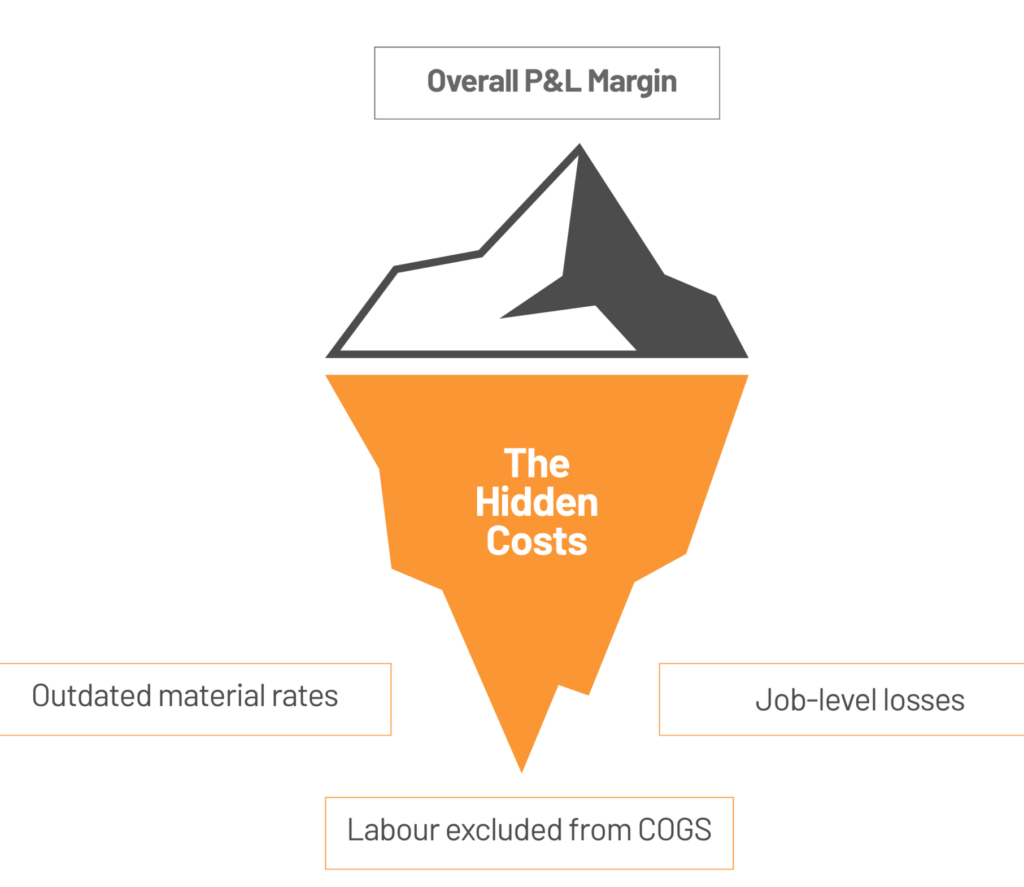
Without project-level margin visibility, you can’t accurately
quote costs, predict cash flow, or know which jobs are
worth taking on. You might know your overal margin, but do
you know which projects are profitable and which ones are
losing you money?
Without project-level margin visibility, you can’t accurately
quote costs, predict cash flow, or know which jobs are
worth taking on. You might know your overal margin, but do
you know which projects are profitable and which ones are
losing you money?
“I’ll often get shown a spreadsheet and be forced to tell the
manufacturer, ‘You haven’t factored labour into your costing — and
wages have nearly doubled since the last time anyone looked. They
assume that because raw components cost $100 and finished
goods sell for $200, they’re making money. But if labour actually
costs $120 per build, they’re losing money on every job.”
SOLUTION ARCHITECT,
MOMENTUM SOFTWARE SOLUTIONS
For custom manufacturers, the risk is magnified. When estimates are built from
partial BOMs or historical averages, even smal design changes can turn a profitable
quote into a loss before production begins.
When deliveries are late because scheduling was off,
jobs weren’t sequenced correctly, or raw materials
didn’t show up on time, it hurts your credibility.
Word travels quickly in tightly networked industries
one lost customer can cascade into a string of lost
opportunities. For larger contracts or tenders where
traceability and control are critical, these slight delays
can result in serious opportunity loss.
“Ultimately, a manufacturer will either
lose customers or hit a scale ceiling.
Their system can handle ten customers a
month — so when demand spikes to
twenty, delays start piling up. Eventually,
they either end up with unhappy
customers, or they pull back to the ten
they can actually service. Either way,
they’ve put a ceiling on their own growth.”
SOLUTION ARCHITECT,
MOMENTUM SOFTWARE SOLUTIONS
When every job is built to a customer’s specification,
late engineering changes are common. But without
clear version control and downstream visibility, a
single change can ripple through procurement,
scheduling, and costing without anyone fully
understanding the impact.

Owners often discover they can’t confidently answer
basic questions about work‐in‐progress – what’s truly
complete, what’s blocked, and what’s already over
budget – until the job is finished.
If any of these sound familiar, it’s a clear sign you need to upgrade your infrastructure:
“I’ll often get shown a spreadsheet and be forced to tell the
manufacturer, ‘You haven’t factored labour into your costing — and
wages have nearly doubled since the last time anyone looked. They
assume that because raw components cost $100 and finished
goods sell for $200, they’re making money. But if labour actually
costs $120 per build, they’re losing money on every job.”
SOLUTION ARCHITECT,
MOMENTUM SOFTWARE SOLUTIONS
In the background, headcount quietly grows to manage the volume of manual work
not to increase capability. The result is more people doing more of the same broken
processes.
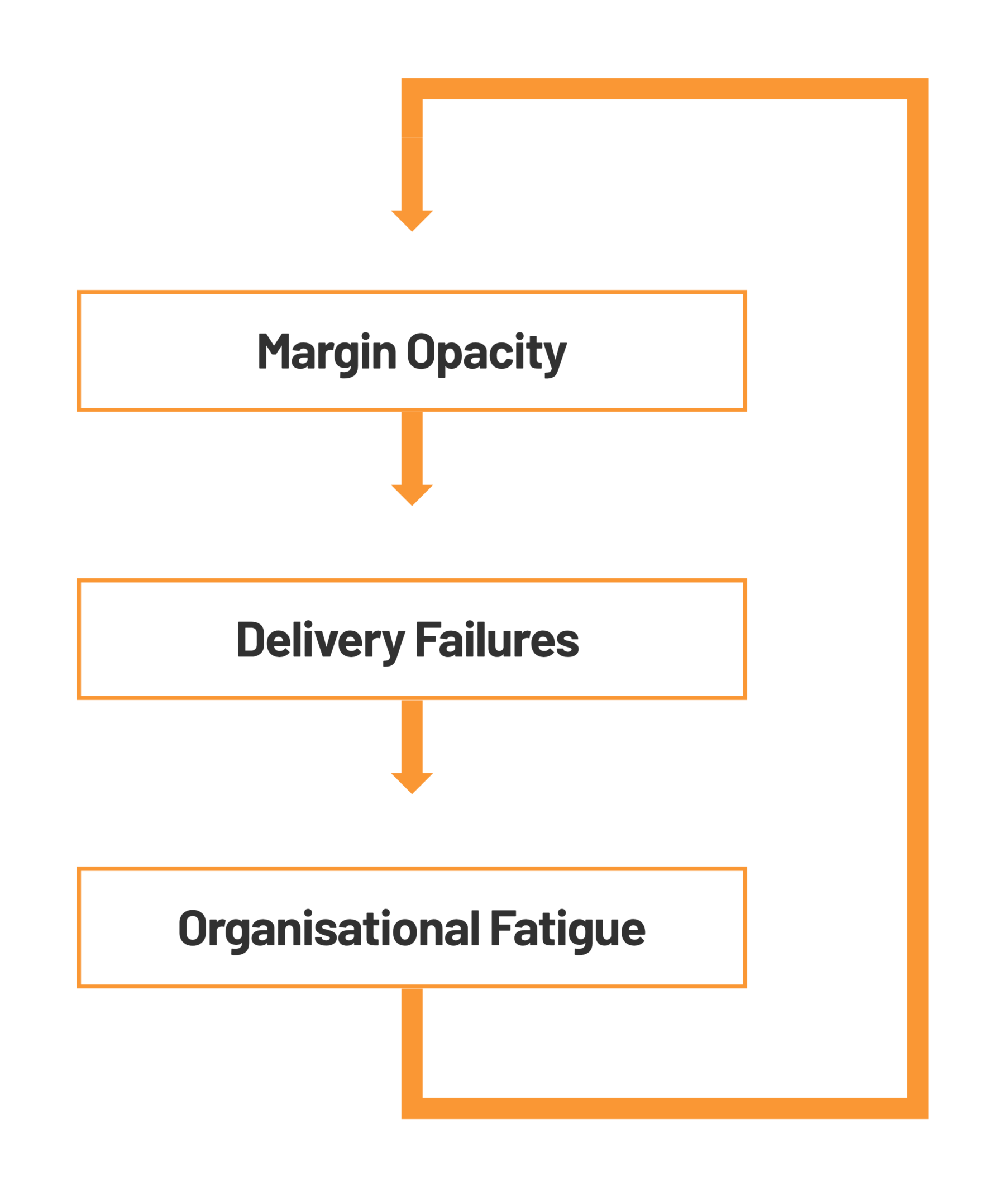
When you’re at work, these problems feel disconnected.
They aren’t
Margin opacity means you can’t accurately price what you
make, and if you’re underestimating cost, you may be
winning jobs that are actually losing you money at scale.
Delivery failures mean you either cap your growth at what
your current system can handle, or you take on more than
you can deliver and start losing the customers you can’t
afford to lose.
Organisational fatigue means the people best placed to
drive change are too deep in daily firefighting to lift their
heads and fix the underlying problem.
These issues only compound the more you grow. If you
don’t act proactively, you’ll be forced to — because you
lose a significant client, margin erosion becomes
unrecoverable, or cash flow tightens to the point where
operational decisions are constrained.
The symptoms we’ve described are all too common among high-growth manufacturers.
The business has since grown to
hundreds of staff with venture
capital backing, and because the
traceability is there, they’re able to
sell directly to the large chains and
supermarkets that require it.
The downstream impact meant engineers could now focus on R&D and process
innovation instead of administrative work. At the same time, the finance team could
cost jobs with precision and confidence because the data they needed flowed
automatically and accurately across every area of the business.
If any of what we’ve covered resonates with you, you’re likely
facing a systems issue – not a people or discipline problem.
At Momentum, we bring over 15 years of experience to solving
systems problems for discrete manufacturers.
We’re experts at implementing manufacturing systems for
complex operations, and we have over 300 successful
deployments to prove it.
Momentum Software Solutions is proudly powered by WordPress